

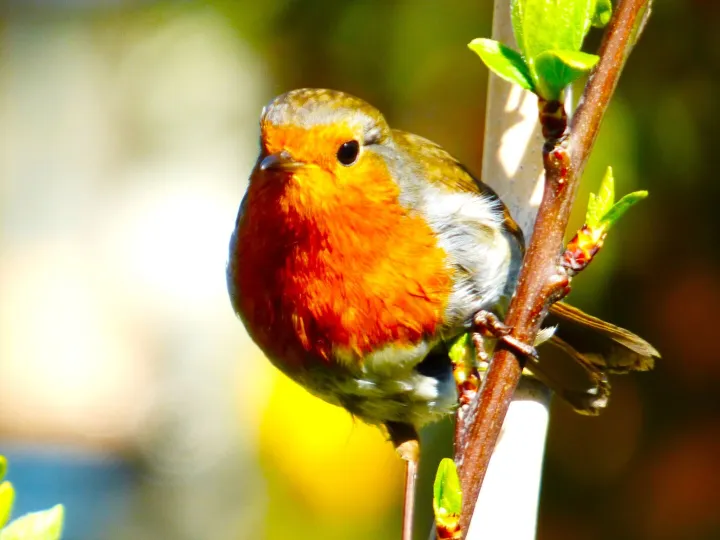
Thinking of Robin by Adrian Leighton
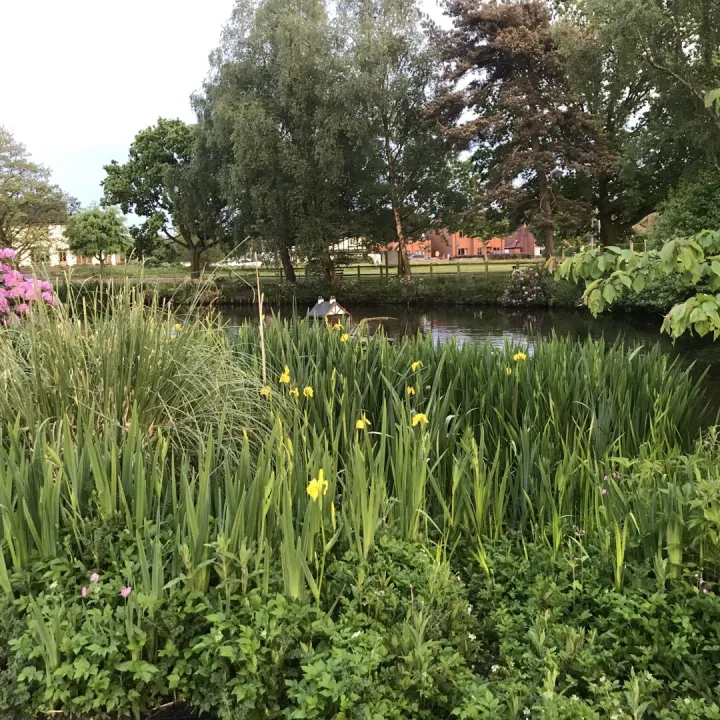
How quiet winter can be. Taking a January walk along the Audlem byways the only sounds that I could hear were those of my own boots. Around me all seems silently resting, under a duvet of grey cosy sky.
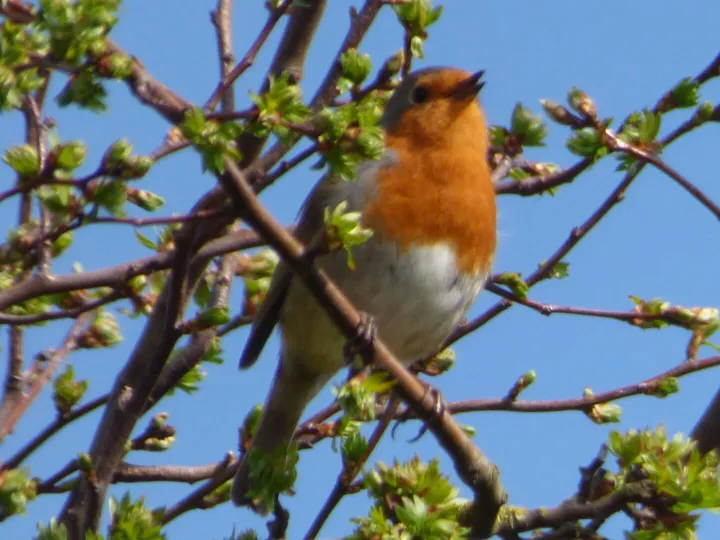
However, from time to time the empty air was filled with a melodious song. Alone in the seemingly deserted landscape was Erithacus rubecula, otherwise known as Robin Redbreast. That my walk took me in range of several of these birds , stretched out along my path, spoke of both their constant presence around us and also of there territorial nature.
The Robin is the nation’s favourite bird, vying with the Blue Tit and the Blackbird.
A familiar subject for Christmas cards and greetings cards of all types, its image is one that inspires a glow of happiness and well-being. This is because, in part, like other creatures Robins have learnt that humans can be a good thing. After all we provide fast food on the bird table and dig up juicy morsels in the garden; as well as providing some handy nesting places in our garden junk.
In return the Robin offers cheerful companionship boosted by its colourful appearance. So much of our attraction to Robins relates to what we get from them. Be it the companionable presence on the garden fork or their song bursting through into our consciousness.
Robin’s are one of a kind, being the sole members of the Erithacus family. However their range extends from Britain throughout Europe east as far as Siberia. It is noted that only those in the British Isles have the confiding attitude to humans whilst the continental birds are usually much more shy. This maybe because they are less likely to be shot at here!
But let’s look at the world though the Robin’s eyes. First it is a smaller bird species, weighing in at 15-20grams (equivalent to two grapes). Its natural predators are birds of prey, including Sparrowhawks, and domestic cats. Despite our human perspective, the male Robin is a feisty creature, especially towards other male Robins.
This is all about protecting its feeding territory. The purpose of the Robin’s song is to mark out territory and to warn off rivals. So if the Robin seems to sing for us as we walk along it is probably not a song of welcome but rather to warns us we are entering their territory.
Our back garden Robin fiercely protects our feeding station from the front garden Robin, both by song but also “handbags at dawn”, if front garden Robin attempts to butt in.
Robins will generally happily feed along side other small birds like blue tits and house sparrows although may have a tussle with another feisty bird, like the Greenfinch. Generally, Robins like feeding on the flat rather than doing gymnastics on a feeder.
If two Robins are happily in the same vicinity, then you can suppose one is a male and one is a female. Even though they look pretty much alike, the differences are that the male is slightly bigger, it has a brighter breast colour and a straight beak compared to the female’s slightly arched beak. Both birds sing, although the male has a courser territorial song. The female builds the nest but the male brings the material. Although the male Robin does not brood the eggs and chicks, he does feed the chicks and at the end of a season can look a “Ragged Robin”.
Of course, Robins are, for us, an all year round bird. Every season, any weather and even at night a Robin may make its presence known by song if not by sight. The happy symbiotic relationship we share, speaks to us in a world of fear and doubt, calling us to find that true relationship with the natural world that human society has abused and misused for so long.
Sing on Erithacus rubecula.


Get In Touch
AudlemOnline is powered by our active community.
Please send us your news and views using the button below:
Email: editor@audlem.org